
Shoulder Pain & Impingement: Why Does Lifting Your Arm Hurt So Much?
Do you feel a sharp, sudden, stabbing pain in your shoulder when you try to reach for a high shelf in the kitchen, put on your shirt in the morning, or hit a powerful overhead smash on the Padel court? Perhaps this deep, nagging ache even wakes you up from a deep sleep the moment you roll over onto your affected side.
Many patients rush to take painkillers or even consider cortisone injections, terrified that they have suffered a severe “tear.” But in reality, the vast majority of these cases come down to a purely mechanical issue known medically as Shoulder Impingement Syndrome.
At Rikaz Chiropractic Clinic in Jeddah, we see daily how a simple movement dysfunction in the back and shoulder can spiral into a debilitating daily struggle. Let us explain the engineering of your shoulder joint, why your tendons are getting pinched, and how we provide root-cause shoulder impingement treatment without surgery or medication.
- Shoulder Pain & Impingement: Why Does Lifting Your Arm Hurt So Much?
- What is Shoulder Impingement? (The Battle of Narrow Spaces)
- The Hidden Culprits: Why Did the Tunnel Narrow?
- 3 Signs You Have Shoulder Impingement
- The Unsung Hero: How Your "Shoulder Blade" Destroys Your Joint
- The Real Danger: What Happens If You Ignore It?
- Mechanical First Aid: Stop Doing This Immediately!
- How Chiropractic Provides Lasting Shoulder Pain Treatment
- The Rikaz Methodology: Precise Athletic & Medical Assessment
- Return to Your Sport and Your Life Without Shoulder Pain!
What is Shoulder Impingement? (The Battle of Narrow Spaces)
The shoulder is the most mobile joint in the human body, but it pays a heavy tax for this flexibility by being highly susceptible to instability.
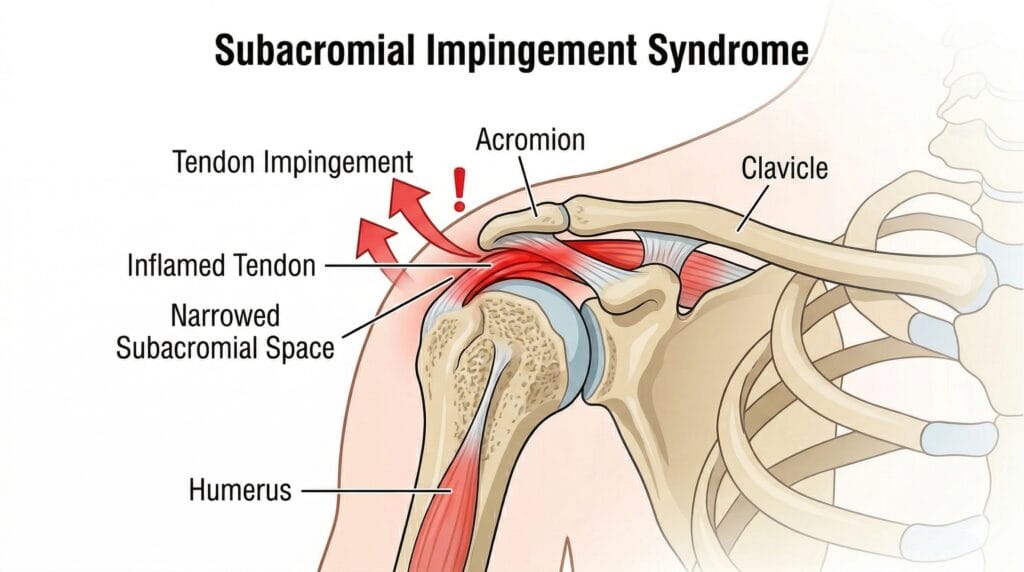
Imagine a very small, bony tunnel (called the Subacromial Space) through which the tendons that lift your arm (the Rotator Cuff tendons) must pass. Normally, these tendons glide smoothly through this tunnel.
However, when the roof of this tunnel collapses or the space narrows, the tendons get trapped and pinched between the bones every time you raise your arm. This constant mechanical friction causes severe inflammation, swelling, and a sharp, stabbing pain!
The Hidden Culprits: Why Did the Tunnel Narrow?
Shoulder impingement does not happen by accident. There are two main mechanical reasons why your bones are suddenly grinding against your tendons:
1. Rounded Shoulders & Upper Back Slouch (The Desk Worker’s Curse)
Remember the Upper Cross Syndrome we discussed previously? When you sit for hours with your shoulders rolled forward, the mechanical position of your “shoulder blade” (Scapula) changes. This forward slump literally tilts the bony roof of the tunnel downward, closing off the space for your tendons. If you try to lift your arm while your back is hunched, you are physically grinding your own tendons!
2. Repetitive Athletic Strain (The Mover’s Curse)
Racquet sports like Padel and tennis, swimming, or CrossFit exercises that require heavy overhead lifting are prime suspects. These rapid, repetitive overhead motions—especially if performed with poor technique or while the muscles are fatigued—cause the tendons themselves to swell. A swollen tendon becomes thicker, making it much more likely to get jammed inside the narrow bony tunnel.
3 Signs You Have Shoulder Impingement
How do you know your pain is a mechanical impingement and not just a standard muscle strain? Look for these classic signs:
- The Painful Arc: You feel no pain when your arm is resting by your side, and no pain when your arm is pointing straight up at the sky. The pain appears suddenly and peaks only in the middle range (when lifting your arm between a 60 to 120-degree angle).
- Agonizing Night Pain: You absolutely cannot sleep on the affected side, and you often feel a deep, throbbing ache that wakes you up if your shoulder moves during the night.
- Weakness When Reaching Backward: You experience a sharp catch and severe difficulty if you try to reach into your back pocket or, for women, when trying to unhook a bra from the back.
The Unsung Hero: How Your “Shoulder Blade” Destroys Your Joint
In biomechanics, lifting your arm overhead is not the job of the shoulder joint alone. The real secret lies in the large, triangular bone on your back: the Scapula (Shoulder Blade).
The engineering rule states: every time you lift your arm, your shoulder blade must rotate upward to open the bony tunnel and let the tendons pass safely. However, due to poor posture or muscle fatigue, the shoulder blade often gets locked in place and loses its ability to rotate (a condition called Scapular Dyskinesis).
The result? When you forcefully lift your arm, the arm bone crashes directly into the roof of the shoulder because the scapula didn’t move out of the way, grinding the tendon between the two bones with every swing!
The Real Danger: What Happens If You Ignore It?
Many patients simply decide to stop using their affected arm, avoiding lifting it to escape the pain, believing the issue will magically fade with time. This neglect opens the door to far worse complications:
- Rotator Cuff Tear: The constant friction of the tendon against the bone is exactly like rubbing a rope against a sharp rock. Over time, the tendon fibers fray and eventually tear partially or completely, turning a simple mechanical inflammation into a severe injury requiring complex surgery.
- Frozen Shoulder (Adhesive Capsulitis): When you stop moving your shoulder due to pain, the joint capsule begins to shrink, stiffen, and form adhesions. Suddenly, you find yourself completely unable to move your arm in any direction (even if someone else tries to lift it for you), and recovering from this agonizing condition can take many painful months.
Mechanical First Aid: Stop Doing This Immediately!
If you are suffering from shoulder impingement, your first instinct might be to aggressively “stretch” the shoulder by forcing your arm overhead or hanging from a pull-up bar or doorframe. Stop doing this immediately! These movements only increase the grinding of the already inflamed tendons.
The Safe Alternative (The Pendulum Exercise):
Instead of lifting your arm, let gravity open the joint for you:
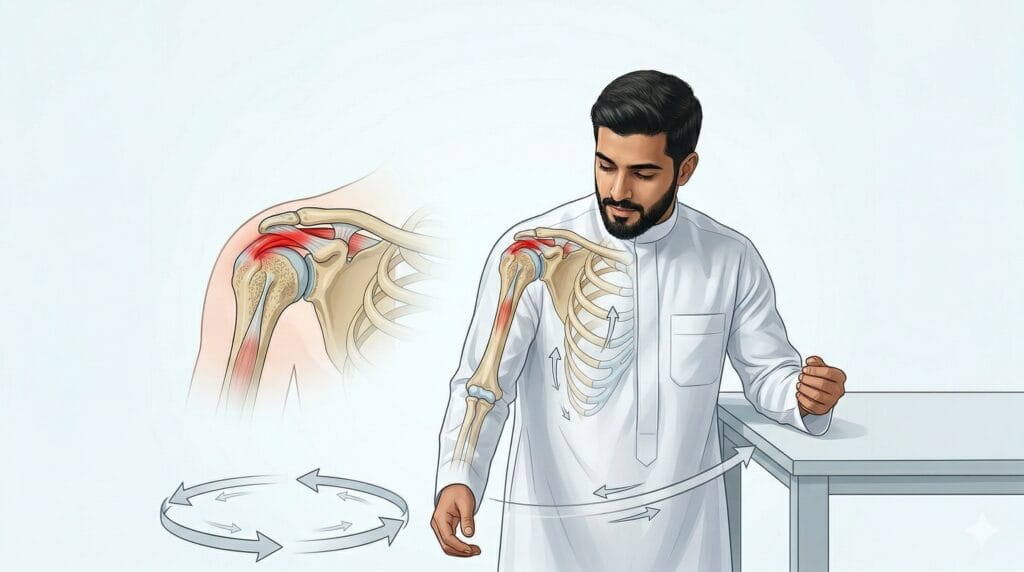
- Stand next to a table and lean your torso forward, supporting your weight with your healthy hand on the table.
- Let your painful arm hang completely loose and relaxed toward the floor (like a pendulum).
- Use the gentle swaying motion of your body (not your shoulder muscles) to make the hanging arm swing very lightly in small circles.
- This exercise creates gentle traction inside the joint, temporarily relieving the suffocating pressure on the inflamed tendons until you can visit the clinic.
How Chiropractic Provides Lasting Shoulder Pain Treatment
Injecting painkillers into the shoulder might hide the pain for a few days, but it does not open the collapsed “bony tunnel.” To fix the problem permanently, the biomechanics of both the shoulder and the upper back must be corrected.
At Rikaz Clinic, our shoulder impingement treatment plan is highly structural and comprehensive:
- Thoracic Spine Adjustments: We start at the foundation! We unlock the stiffness in your upper back. Your shoulder simply cannot function correctly if your upper spine is hunched and rigid. Restoring an upright posture instantly opens up the bony tunnel.
- Shoulder and Scapula Realignment: We use gentle manual techniques to ensure that the shoulder joint (Glenohumeral joint) and the shoulder blade (Scapula) are moving in perfect harmony without any mechanical blockage.
- Myofascial Release: We apply precise pressure to the muscles surrounding the rotator cuff to release tight muscle knots, easing the tension that pulls the shoulder joint out of its correct alignment.
The Rikaz Methodology: Precise Athletic & Medical Assessment
The shoulder is a highly complex joint, and treating it requires an expert who understands the body’s entire kinetic chain.
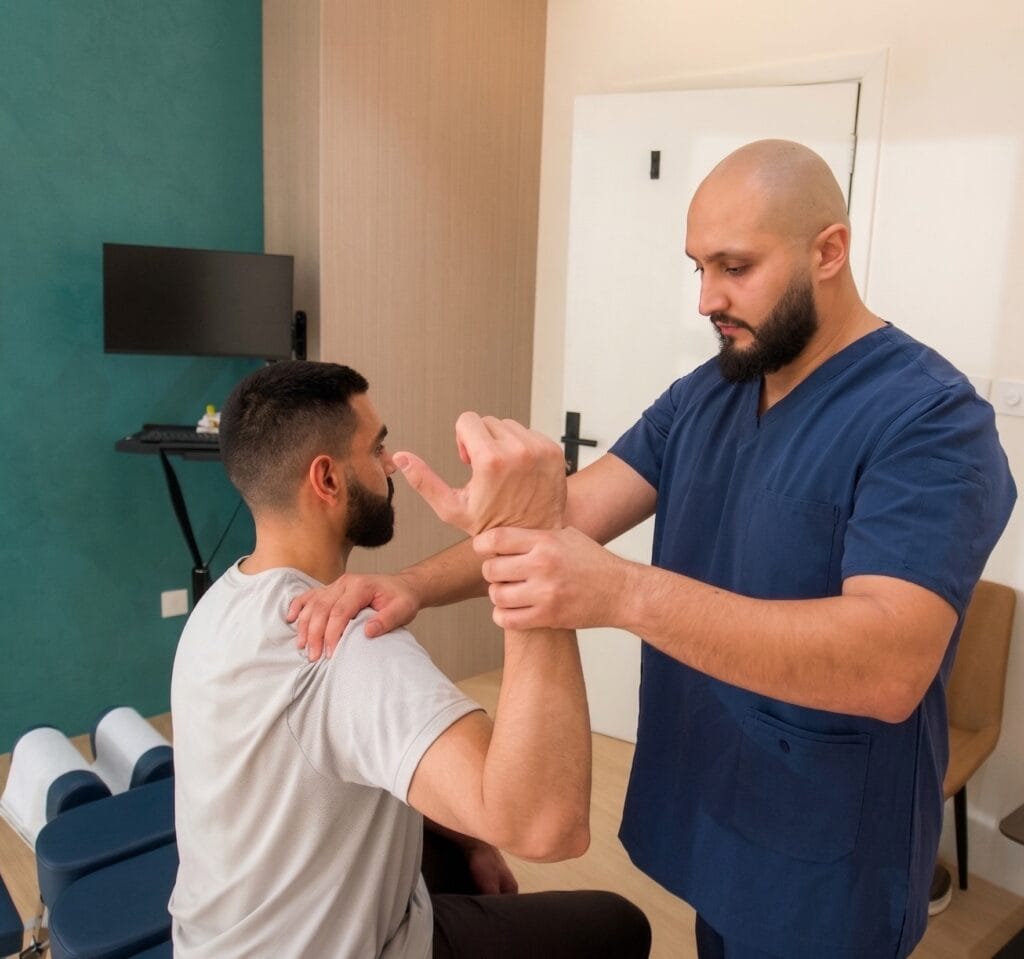
Led by Dr. Mohammad Yashar, who underwent 5 years of rigorous academic and clinical training at the prestigious RMIT University in Melbourne, Australia, we perform specialized orthopedic tests (like the Neer Test and Hawkins-Kennedy Test). These tests precisely isolate the affected tendons and rule out complete tears before any manual treatment begins.