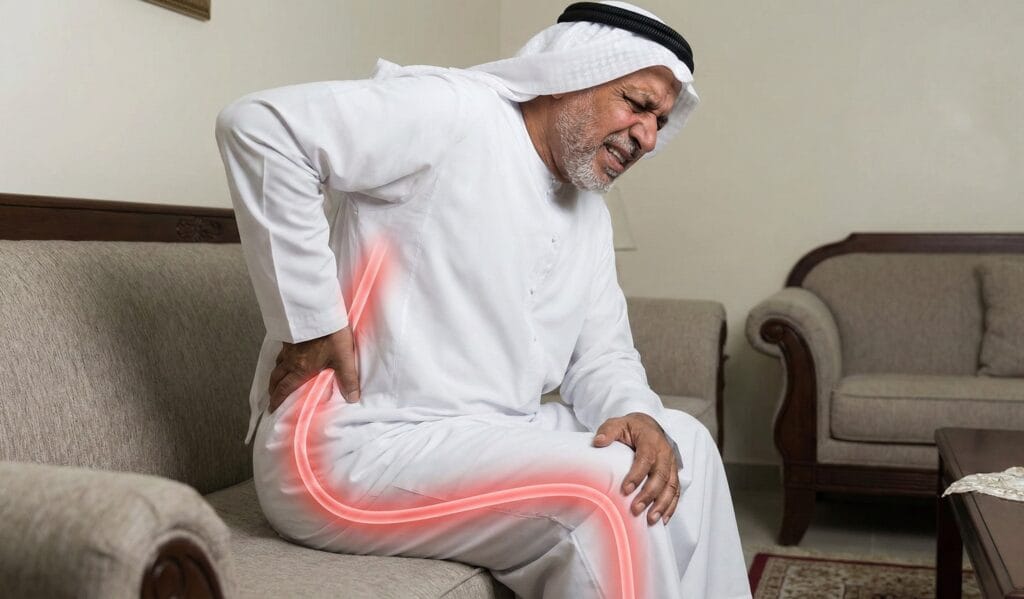
Herniated Disc (Slipped Disc): Is Surgery Your Only Option?
The moment you hear an MRI doctor diagnose you with a “herniated disc” or a “slipped disc,” your heart rate might spike, and terrifying thoughts often rush into your mind. The fear of losing mobility, the anxiety of taking long medical leaves, and the biggest question of all: Will I need spinal surgery?
In a fast-paced city like Jeddah, where long hours of driving and prolonged desk work are the norm, disc injuries have become incredibly common. But the great news we share with our patients at Rikaz Clinic is this: Surgery should not be your first option; it should be your absolute last resort.
Modern medical studies confirm that the vast majority of patients seeking herniated disc treatment without surgery successfully recover and regain their normal, pain-free lives when the mechanical root cause is properly addressed.
- Herniated Disc (Slipped Disc): Is Surgery Your Only Option?
- What Exactly is a Herniated Disc? (A Simple Medical Breakdown)
- How Do You Know If You Have One? (Common Symptoms)
- The Myth of the "Slipped" Disc: Can Your Body Heal Itself?
- The Role of Chiropractic in Healing Discs Without Surgery
- Vital Daily Habits for Disc Injury Patients
- The Rikaz Methodology: Safety, Precision, and Comprehensive Assessment
- Are You Ready to Return to a Pain-Free Life?
What Exactly is a Herniated Disc? (A Simple Medical Breakdown)
To understand the problem, let’s visualize your spine. Between each bony vertebra sits an “intervertebral disc.” These discs act as shock absorbers, providing flexibility and movement to your back.
Think of this disc exactly like a “jelly donut”:
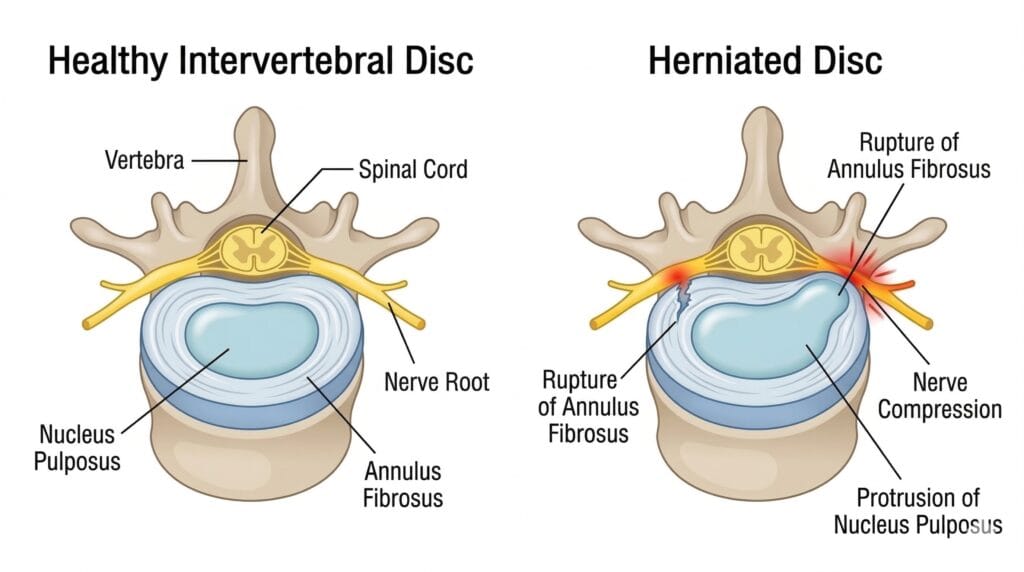
- The Outer Shell (Annulus Fibrosus): A tough, durable, fibrous ring that protects the inside of the disc.
- The Inner Core (Nucleus Pulposus): A soft, gel-like substance in the center.
When your spine is subjected to constant pressure (like years of poor sitting posture) or sudden trauma (like lifting a heavy weight with a rounded back), the tough outer layer can weaken or tear. This allows the inner gel to push outward. This protrusion is what we medically call a Herniated Disc.
How Do You Know If You Have One? (Common Symptoms)
The pain of a herniated disc is rarely confined just to the back. In fact, the real trouble begins when that protruding gel presses against the nearby sensitive spinal nerves. Common symptoms include:
- A sudden, sharp pain in the lower back that severely worsens when coughing or sneezing.
- Numbness, tingling, or a “pins and needles” sensation extending into your limbs.
- Noticeable muscle weakness in your leg or foot.
- Feeling a sharp, electric shock-like pain traveling from your glutes all the way down your leg, a condition medically known as Sciatica
The Myth of the “Slipped” Disc: Can Your Body Heal Itself?
There is a very common misconception that a disc “slips out of place” and can just be “pushed back in” with a forceful thrust. Spinal discs are firmly attached to the vertebrae above and below them; they do not slip around like bars of soap. What happens is a tear and a bulge.
So, how does herniated disc treatment without surgery actually work?
The secret lies in human physiology. Your body possesses a remarkable healing system. When provided with the correct biomechanical environment, your immune system will actually attack the protruding part of the disc and dissolve it (a process called Phagocytosis). Furthermore, the disc reabsorbs fluids and shrinks, gradually taking the pressure off the nerve. Our job is to remove the mechanical barriers so this natural process can happen faster.
The Role of Chiropractic in Healing Discs Without Surgery
At Rikaz Clinic, we believe that simply masking disc pain with strong painkillers is dangerous, as it might encourage you to perform movements that tear the disc further. Instead, the chiropractic specialty focuses on correcting the biomechanics of your entire spine.
Here is how we help you heal:
- Restoring Joint Mobility: Through gentle, highly calculated manual adjustments, we restore movement to the stiff vertebrae (subluxations) located above and below the injured disc, significantly reducing the mechanical load on the injury.
- Spinal Decompression: Improving your overall spinal alignment helps create more vertical space for the irritated disc, reducing its friction against the spinal nerve.
- Nervous System Regulation: 🔗 [Internal Link Placement]: Removing structural tension from the spine helps in [Regulating the Nervous System – Insert Link to Wellness/Nervous System Page here], which lowers pain signals and stimulates your body’s innate healing response.
Vital Daily Habits for Disc Injury Patients
To accelerate your recovery journey and prevent the disc bulge from worsening, we highly recommend adhering to these mechanical rules:
- Avoid Bending and Twisting Simultaneously: This is the absolute worst movement for a spinal disc. If you need to pick something up from the floor, squat down by bending your knees and keep your back perfectly straight.
- Hydrate Abundantly: Your spinal discs are mostly made of water. Dehydration makes the discs brittle and much more susceptible to tearing.
- Mindful Walking: Sitting places significantly more pressure on your lower back than standing. Taking short, frequent walks pumps vital blood and nutrients into the injured cartilage.
Pay close attention to your daily ergonomics, as poor posture is often the hidden culprit behind the chronic Lower Back Pain you are experiencing.
The Rikaz Methodology: Safety, Precision, and Comprehensive Assessment
Dealing with a herniated disc requires extreme caution and deep medical knowledge. You should never undergo random, forceful manual therapy when a disc is compromised.
At Rikaz Chiropractic Clinic in Jeddah, under the expert guidance of Dr. Mohammad Yashar—a graduate of the rigorous 5-year program at RMIT University in Melbourne, Australia—we place “Safety” as our ultimate priority.
Your journey for herniated disc treatment without surgery starts with a comprehensive assessment:
- Conducting precise neurological and orthopedic examinations.
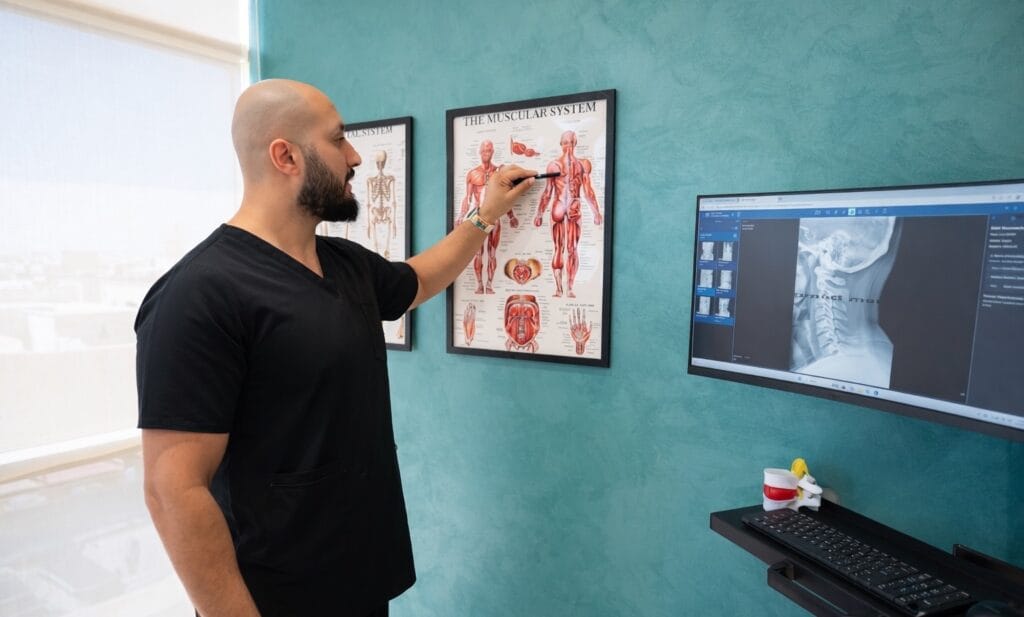
- Carefully reading and analyzing your MRI scans to determine the exact location and size of the herniation.
- Designing a customized treatment plan that does NOT rely on random “cracking,” but on gentle, scientific adjustments and rehabilitation exercises that ensure the long-term stability of your spine.