Upper Back Pain: Is it Just a Muscle Spasm or a Hidden Spinal Issue?
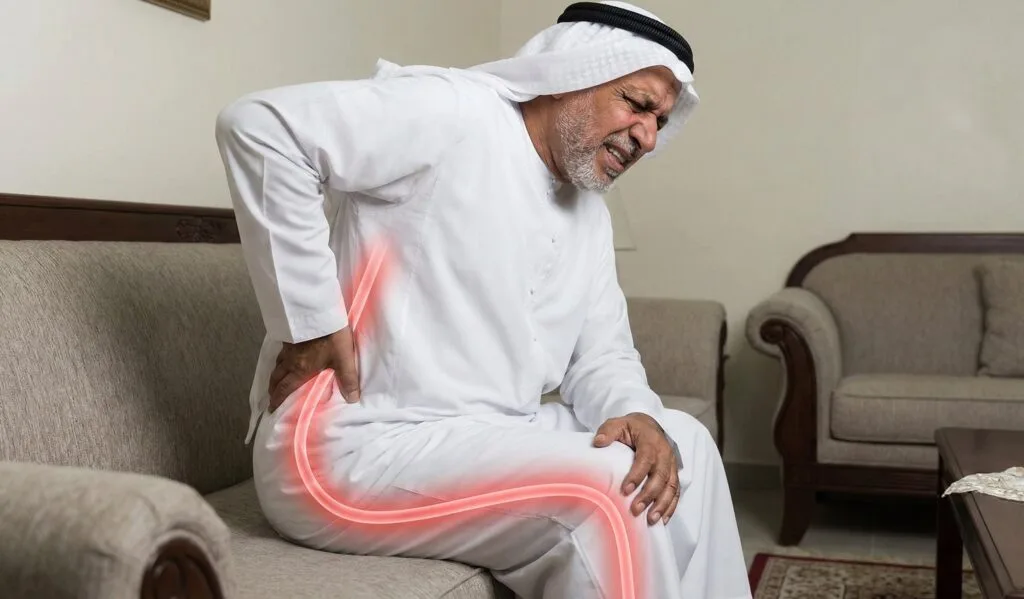
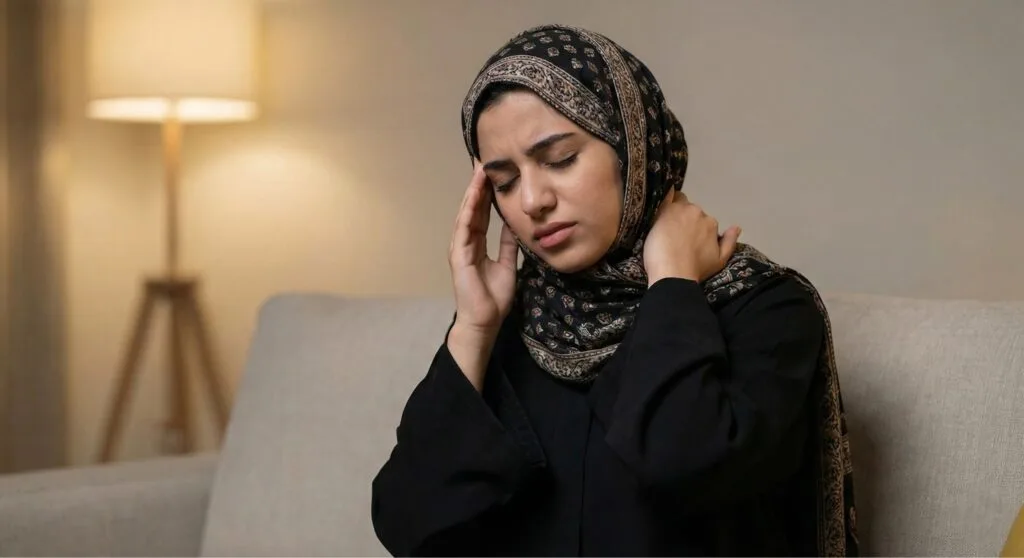
Do you feel a sharp, nagging pain right between your shoulder blades? A stabbing sensation that gets worse when you take a deep breath, or when you turn your steering wheel while navigating Jeddah’s busy traffic?
In Saudi culture, this frustrating upper back pain is widely known as “Al-Abhar.” Many people, both locals and expats, try to get rid of it through intense deep tissue massages, asking a friend to walk on their back, or resorting to traditional “cracking” methods. You might feel temporary relief for a few hours or days, but the pain almost always comes back, often stronger than before.
Why does this happen? Because a standard massage treats the “symptom” while completely ignoring the “root cause.” At Rikaz Chiropractic Clinic in Jeddah, we take you on a scientific journey to understand what this pain truly is, and how we provide effective, long-term upper back pain treatment.
- Upper Back Pain: Is it Just a Muscle Spasm or a Hidden Spinal Issue?
- What is This Pain Medically and Anatomically?
- The Root Causes: Why Are You Suffering from It?
- Why Don't Massages or Painkillers Make the Pain Disappear?
- How Chiropractic Provides Lasting Upper Back Pain Treatment
- 3 Safe At-Home Steps to Relieve Upper Back Pain Today
- The Rikaz Methodology: Australian Healthcare Standards in Jeddah
- Don't Live with the Pain… Start Your Healing Journey Today!
What is This Pain Medically and Anatomically?
Whether you call it Al-Abhar or simply a stiff back, this is a severe muscle spasm or mechanical dysfunction in your Thoracic Spine (the middle and upper section of your back).
Medically speaking, this pain is usually linked to one or more of the following anatomical structures:
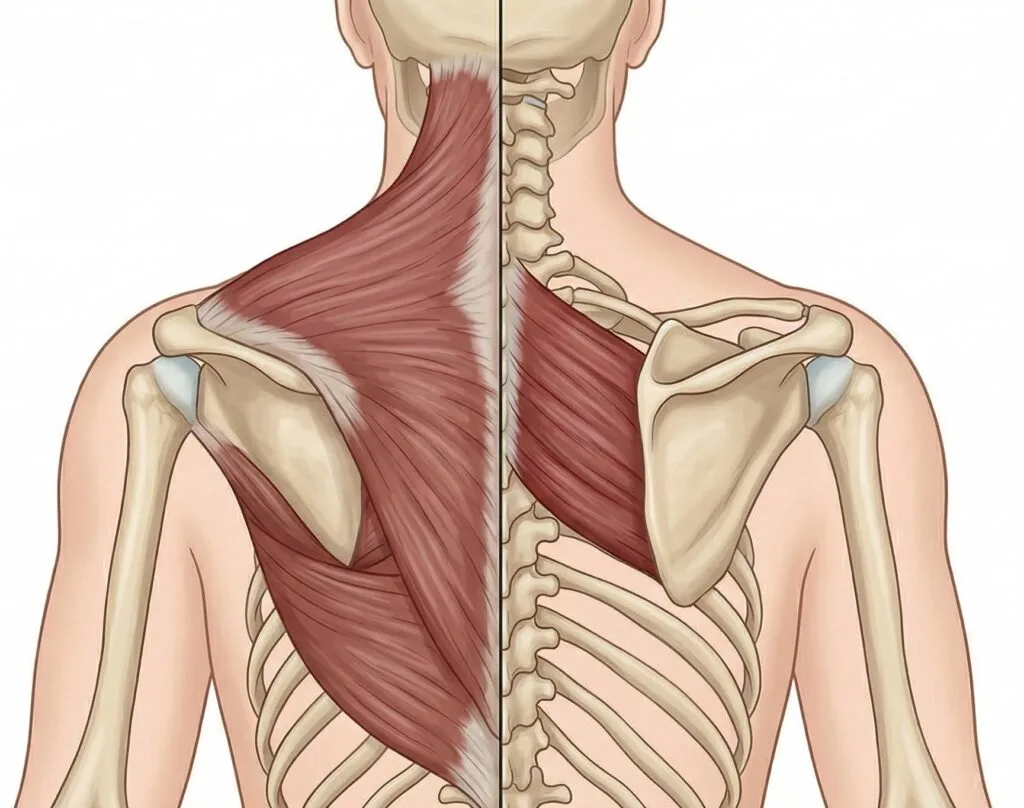
- The Rhomboid Muscles: These are the muscles that connect your shoulder blades (scapula) to your spine. When these muscles weaken or undergo constant strain from poor posture, they develop highly painful “trigger points” or muscle knots.
- Costovertebral Joints: This is the precise location where your ribcage connects to your spinal vertebrae in the back. Any locking, restriction, or loss of mobility in this tiny joint causes a sharp, stabbing pain that expands when your lungs fill with air.
- Cervical Referred Pain: Often, the true source of the pain isn’t in your back at all. A compressed or irritated nerve in your lower neck can send “referred pain” signals that settle right between your shoulder blades.
The Root Causes: Why Are You Suffering from It?
The human body is incredibly smart; a muscle does not spasm without a reason. A muscle spasm is simply your body’s way of “protecting” an unstable joint or a vertebra that isn’t moving correctly. Here are the main reasons this upper back pain develops:
- Poor Posture and the Corporate Desk Life
The number one cause for our patients in Jeddah is the corporate, sedentary lifestyle. Sitting for long hours in front of a computer screen with rounded shoulders leads to a phenomenon medically known as “Reciprocal Inhibition.”
When you hunch forward, your chest muscles shorten and tighten, pulling your shoulders forcefully to the front. As a reaction, your upper back muscles are forced to stretch and overwork all day long to pull your shoulders back. This constant tug-of-war exhausts the muscles, leading to painful, chronic spasms. - Thoracic Subluxation (Mechanical Joint Dysfunction)
The thoracic spine is designed to be highly mobile and capable of twisting. A lack of movement (from sitting all day) makes these vertebrae stiff and “locked.” When the spinal joints lock up, the surrounding muscles are forced to compensate and work overtime, creating those painful knots that you constantly try to rub out. - Incorrect Physical Strain
Lifting heavy objects improperly, carrying heavy grocery bags on one side, or performing resistance training at the gym with bad form can lead to a micro-sprain in the joint connecting the rib to the vertebra.
Why Don’t Massages or Painkillers Make the Pain Disappear?
Imagine the fire alarm is ringing loudly in your house. Taking painkillers is like putting earplugs in so you can’t hear the sound, while a traditional massage is like turning off the alarm entirely… but the fire is still burning!
- Painkillers: They temporarily block the pain signals your brain is receiving, but they do nothing to fix the mechanics of your spine.
- Massages: They relax the spasming muscle and increase blood flow, which feels amazing. However, the moment you go back to sitting at your desk, the mechanical dysfunction in your spinal joint (the true root cause) will force the muscle to spasm all over again to protect the spine.
This is exactly why you need precise, structural upper back pain treatment from a Doctor of Chiropractic.
How Chiropractic Provides Lasting Upper Back Pain Treatment
At Rikaz Chiropractic, we don’t just offer surface-level muscle rubs. We actively diagnose and correct the mechanical dysfunction that forced your muscle to spasm in the first place.
A Doctor of Chiropractic relies on precise manual adjustments to achieve the following:
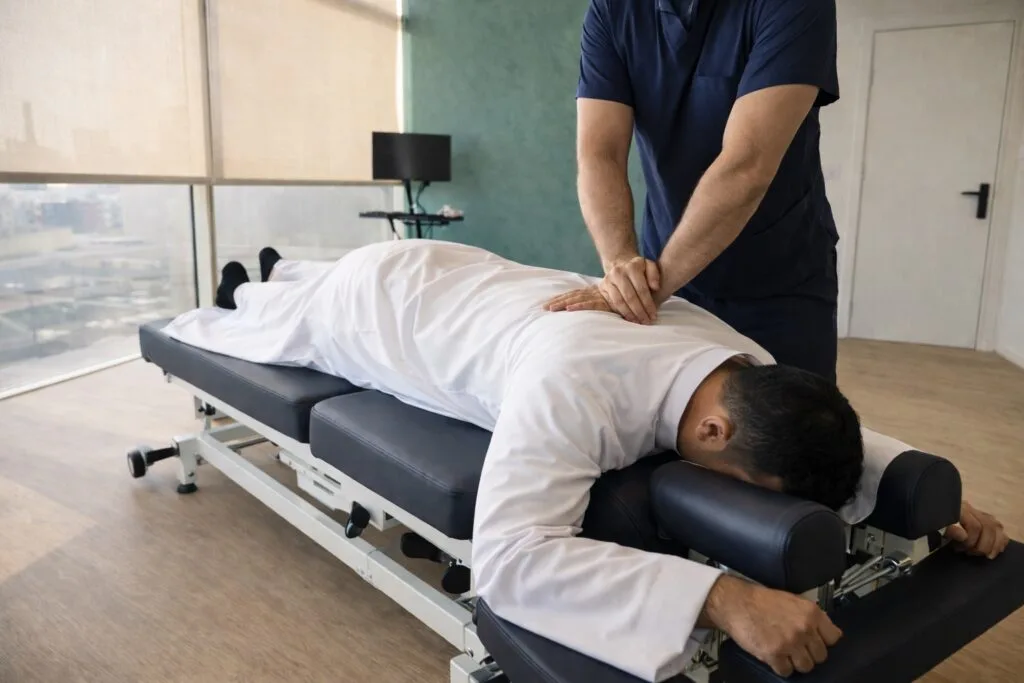
- Releasing Locked Joints: Restoring natural movement to the thoracic vertebrae and rib joints, which instantly removes mechanical pressure and allows you to breathe easily again.
- Relieving Neurological Stress: Improving communication between the nervous system and the muscles. This sends a neurological signal to the brain that “the danger is gone,” allowing the muscle to relax naturally without aggressive massaging.
- Correcting Spinal Alignment: Restoring the natural curves of your neck and back to reduce future strain. Learn more about how we fix your daily alignment on our Posture Correction page.
3 Safe At-Home Steps to Relieve Upper Back Pain Today
Until we see you in the clinic for a comprehensive assessment, here is some mechanical “first aid” you can safely apply at home or in the office:
- The Doorway Stretch: Stand in a doorway, place your forearms on the sides of the doorframe, and slowly lean your body forward. Stretching your tight chest muscles will relieve the opposing tension placed on your upper back.
- The Tennis Ball Release: Place a tennis ball between your back and a wall (specifically on the pain point between the shoulder blade and the spine). Lean back gently and move your body up and down to massage out the superficial muscle knot.
- Warm Compresses: Apply a warm heating pad for 15 minutes to the painful area to increase blood circulation and help relax the acute spasm before going to sleep.
The Rikaz Methodology: Australian Healthcare Standards in Jeddah
Proper upper back pain treatment should never be a random, forceful process. At Rikaz Chiropractic Clinic, led by Dr. Mohammad Yashar (a graduate of RMIT University in Melbourne, Australia), we adopt strict medical standards that rely on a comprehensive assessment first.
We do not just “crack backs” to hear a sound! We start with:
- Studying your health history and workplace ergonomics.
- A precise, hands-on examination of your posture and joint mobility.
- Neurological and muscular testing to determine if the pain originates from your neck or your thoracic spine.
- Designing a customized chiropractic adjustment plan, along with specific rehabilitative exercises to ensure the pain stays away permanently.
We operate under the supervision and licensing of official health authorities in Saudi Arabia, guaranteeing you a safe, professional, and highly effective healing environment.