SI Joint Pain (Back Dimple Pain): Hidden Causes and Lasting Treatment
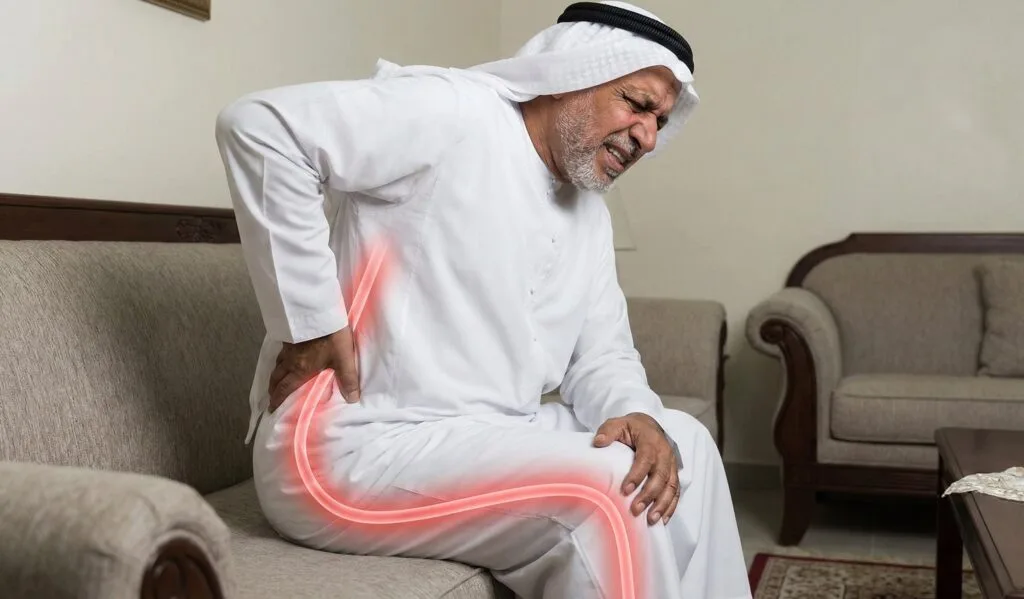
Have you ever stood up from your desk after a long workday, only to feel a sharp, stabbing pain localized in a very specific spot in your lower back—right around those small bony bumps just above your buttocks, commonly known as “back dimples”?
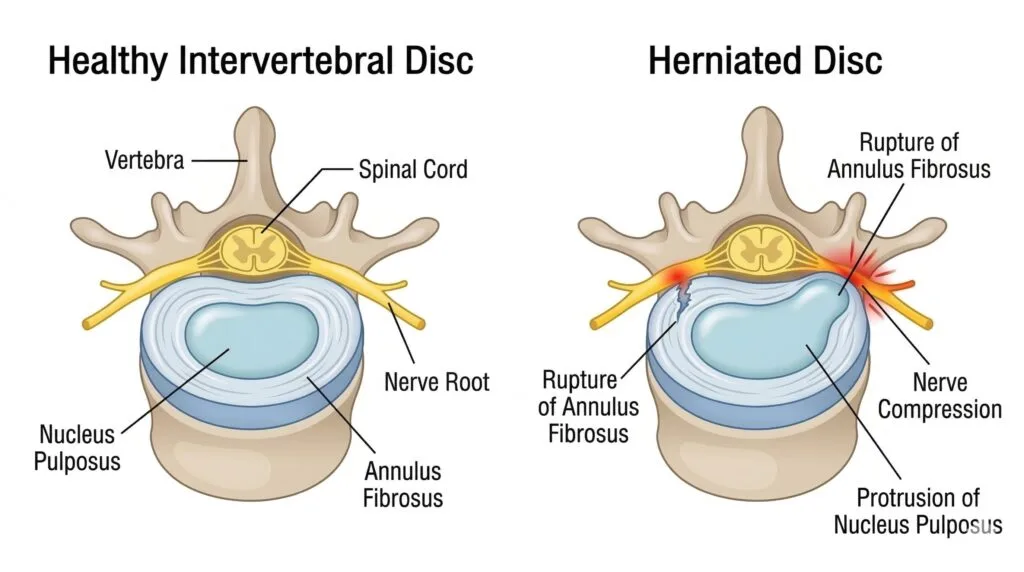
This pain often radiates into your glutes or the back of your thigh, making you immediately rush to Google, convinced you have a herniated disc or sciatica. However, in many cases, the real culprit behind this agonizing pain is not a spinal disc at all. It is a mechanical dysfunction in a small, incredibly strong joint known medically as the Sacroiliac Joint (SI Joint).
At Rikaz Chiropractic Clinic in Jeddah, we pride ourselves on precise diagnostics that distinguish between standard lower back pain and deep pelvic issues. Let us take you on a simplified journey to understand the true source of your pain and how we eliminate it using natural, mechanical methods.
- SI Joint Pain (Back Dimple Pain): Hidden Causes and Lasting Treatment
- The Medical Secret Behind Your Pain: Meet the SI Joint
- Why Does This Joint Inflame and Cause Severe Pain?
- 4 Signs Your Pain is the SI Joint, Not Sciatica or a Disc
- Chiropractic Care: The Effective Mechanical Solution Without Injections
- The Rikaz Methodology: Accurate Diagnosis is Half the Cure
- Eliminate the Agony of Sitting and Standing Today!
The Medical Secret Behind Your Pain: Meet the SI Joint
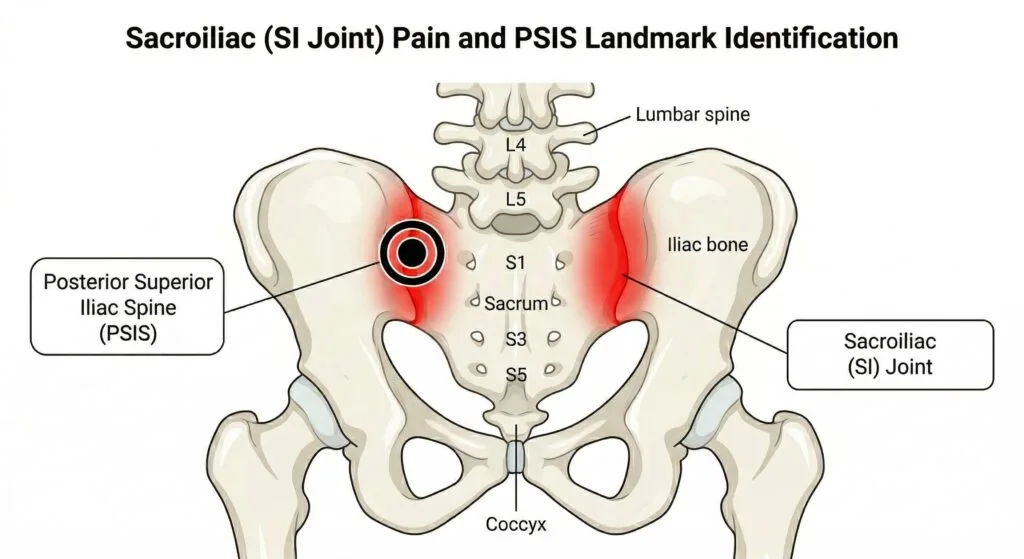
To understand why you are experiencing this highly localized pain, we need to look at a crucial piece of your body’s engineering. The primary suspect for this specific discomfort is inflammation or mechanical dysfunction of the Sacroiliac Joint (SIJ).
You have two of these joints (one on the right, one on the left). They are the critical junctions that connect the base of your spine (the sacrum) to your large pelvic bones (the ilium). Unlike your knees or shoulders, the SI joint is not designed for wide movements. Instead, it acts as a massive “shock absorber,” transferring the weight of your upper body directly to your legs when you walk or run.
Patient complaints usually center around a specific anatomical point called the PSIS (Posterior Superior Iliac Spine). This is the prominent bony bump you can feel under your skin (the back dimple). It serves as the main anchor point for the thick, powerful ligaments that hold the joint together. When the SI joint becomes inflamed, the PSIS becomes extremely tender and painful to the touch!
Why Does This Joint Inflame and Cause Severe Pain?
The SI joint is designed to move only a few millimeters. The debilitating symptoms of SI joint pain occur when this natural movement shifts to one of two extremes:
1. Hypermobility (Instability and Looseness)
This happens when the ligaments supporting the joint become too relaxed, allowing the joint to move excessively, which creates painful friction and inflammation.
- Common Cause: Pregnancy and childbirth! A woman’s body releases a hormone called “Relaxin” to loosen the pelvic joints in preparation for delivery. This makes women highly susceptible to Pelvic Tilt Issues and postpartum SI joint pain due to joint instability.
2. Hypomobility (Mechanical Locking)
This occurs when the joint “locks up” and loses its natural, gliding motion, resulting in severe stiffness and sharp pain.
- Common Cause: Sitting for excessively long periods with poor posture, suffering a direct trauma (like a hard fall on your tailbone), or having the bad habit of constantly shifting your body weight onto one leg while standing.
4 Signs Your Pain is the SI Joint, Not Sciatica or a Disc
Because the symptoms heavily mimic herniated discs, here is how you can determine if your pelvis is the true source of your agony:
- The “One-Finger” Test: Patients with disc issues usually point to a broad, generalized ache across their lower back. If your SI joint is the problem, you can almost always point a single finger precisely at the epicenter of the pain (right on top of the back dimple).
- “Transitional” Pain: The pain reaches its absolute peak during transitional movements, such as trying to stand up from a seated position, getting out of a car, or rolling over in bed at night.
- One-Sided Leg Pain That Stops at the Knee: The pain may radiate deep into your glutes and the back of your thigh, but it rarely travels below the knee (unlike true Sciatica, which shoots like an electric shock all the way down to the toes).
- Stair-Climbing Agony: The pain significantly worsens when you climb stairs or jog. These movements require your body to load its entire weight onto one side of the pelvis with every single step, heavily compressing the inflamed joint.
Chiropractic Care: The Effective Mechanical Solution Without Injections
Many patients resort to cortisone injections directly into the joint to temporarily silence the pain. However, this procedure completely fails to address the “mechanical dysfunction” (the actual reason the joint is locked or unstable).
At Rikaz Clinic in Jeddah, we use chiropractic care to provide a profound, root-cause SI joint pain treatment:
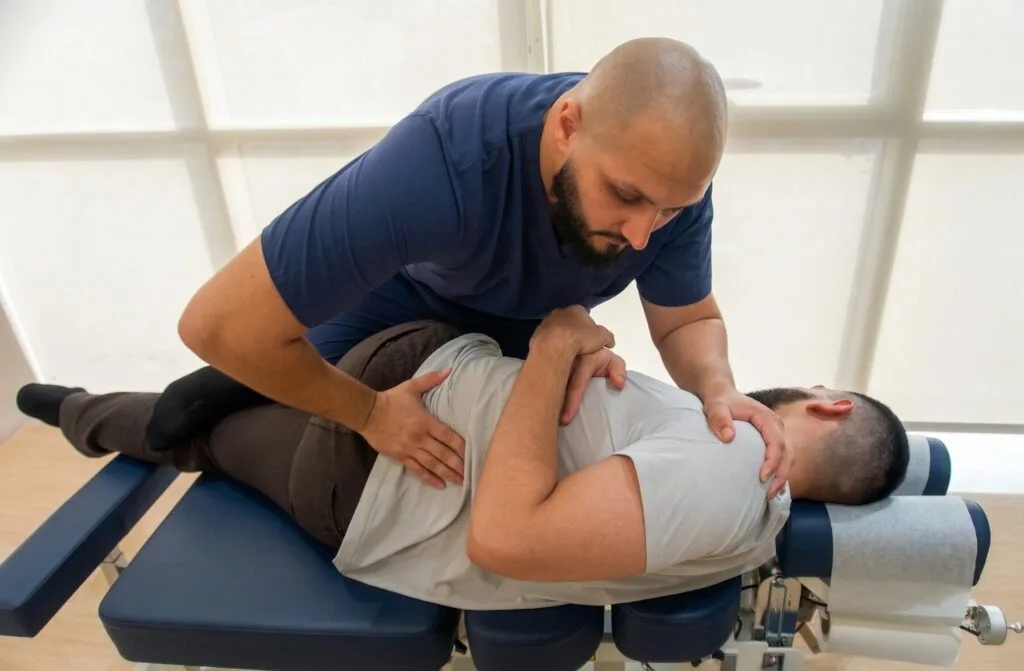
- Precise Chiropractic Adjustments: If the joint is “locked,” your Doctor of Chiropractic will apply a highly specific, quick, and gentle force to the pelvic bone. This frees the joint, restores its natural gliding motion, and instantly removes the mechanical pressure from the inflamed ligaments.
- Advanced Drop Table Technique: We utilize specialized medical examination tables equipped with “drop pieces.” This technology allows us to adjust the pelvis with maximum effectiveness while using significantly less physical force, ensuring a highly comfortable and safe experience for the patient.
- Muscular Rebalancing: We don’t just stop at the adjustment. We focus on releasing tight, spasming muscles in the glutes (like the Piriformis muscle) and guiding you through specific strengthening exercises to stabilize the joint and prevent the pain from returning.
The Rikaz Methodology: Accurate Diagnosis is Half the Cure
Dealing with complex pelvic pain requires surgical precision in biomechanical assessment. No manual therapy should ever be applied without being 100% certain of the true source of the pain.
Under the expert guidance of Dr. Mohammad Yashar (who graduated with honors after 5 years of rigorous academic and clinical training at RMIT University in Australia), we perform a series of specialized orthopedic and neurological tests (such as SI Joint Provocation Tests). These tests isolate the pelvic joint to confirm it is the actual pain generator before any treatment plan begins.
We operate under strict Australian healthcare protocols, ensuring you receive care in an environment that is safe, precise, and heavily grounded in evidence-based medicine.