Pelvic Tilt: What Happens When Your Body’s “Foundation” is Uneven?
Imagine building a towering skyscraper. If the concrete foundation of that building is tilted by even just a few centimeters, the upper floors will suffer from massive structural stress, and cracks will inevitably begin to show in the walls.
Your body operates using the exact same architectural principles. Your pelvis is the solid foundation upon which your entire spine rests; it is the vital connecting point between the upper and lower halves of your body. When a pelvic tilt occurs, your entire body is forced to mechanically compensate, triggering a chain reaction of nagging pain that starts in your lower back and can reach all the way up to your neck or down to your knees.
At Rikaz Chiropractic Clinic in Jeddah, we see patients every day who are unsuccessfully trying to treat their pain with medications, simply because they are ignoring the root structural issue. In this comprehensive guide, we will explain the different types of pelvic tilt, how it secretly destroys your posture, how to test for it at home, and how we can restore your body’s natural balance.
- Pelvic Tilt: What Happens When Your Body's "Foundation" is Uneven?
- What Are the Common Types of Pelvic Tilt?
- The Kinetic Chain: How a Tilted Pelvis Destroys Other Joints
- 4 Hidden Daily Habits That Twist Your Pelvis
- 4 Symptoms Telling You It's Time for Pelvic Tilt Treatment
- A Quick At-Home Test: Do You Have an Anterior Pelvic Tilt?
- Simple Home Exercises to Jumpstart Your Pelvic Alignment
- How Chiropractic Provides Lasting Pelvic Tilt Treatment
- The Rikaz Methodology: Precise Biomechanical Engineering
- Regain Your Balance and Walk Pain-Free!
What Are the Common Types of Pelvic Tilt?
Your pelvis is not just one solid block of bone; it is a complex ring made of several bones connected to your spine via two crucial joints (the Sacroiliac or SI joints). Your pelvis can tilt in several directions, but these two are the most common pain-causing culprits:
1. Anterior Pelvic Tilt (The Forward Tilt)
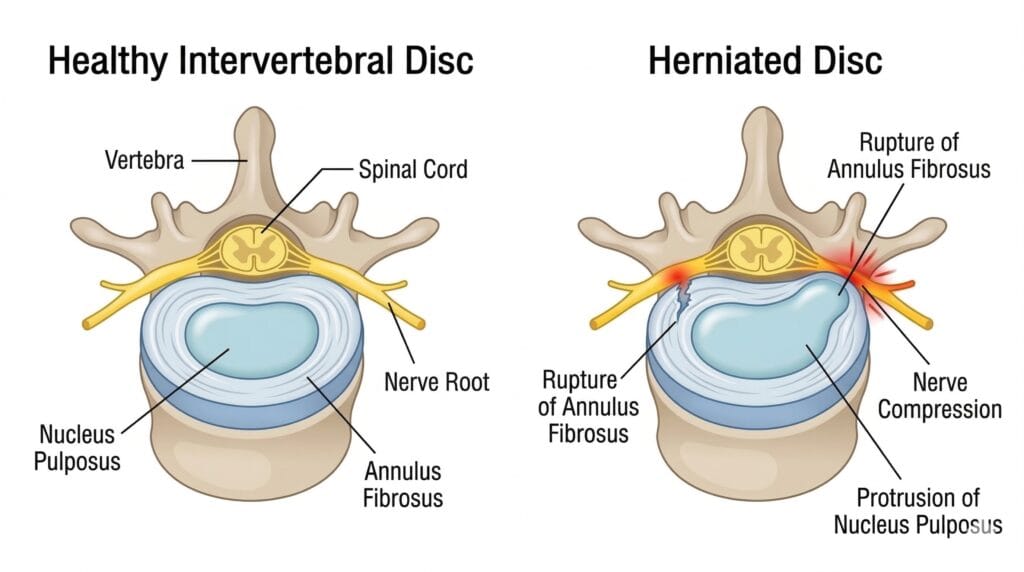
This is by far the most widespread type, especially among office workers. In this condition, the front of the pelvis drops forward and downward.
- How does it look? You will notice an exaggerated, deep arch in your lower back (Hyperlordosis). Your stomach will protrude forward (even if you are relatively thin), and your glutes will stick out unusually far backward.
- The Root Cause: Sitting for long hours causes your “hip flexor” muscles to become incredibly tight and shortened. These tight muscles aggressively pull the front of your pelvis down, which is usually accompanied by very weak abdominal and glute muscles.
2. Lateral Pelvic Tilt (The Sideways Drop)
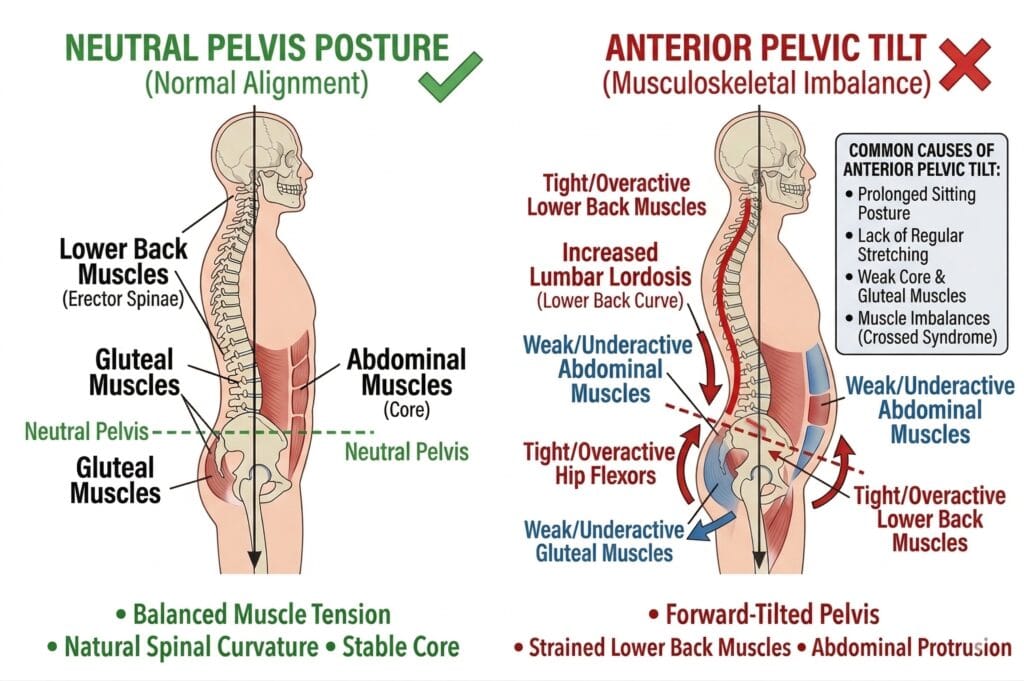
In this scenario, one side of your pelvis (right or left) sits higher than the other when looking at you from the front or back.
- How does it look? It will visually appear as though one of your legs is longer than the other. You might notice that your belt line always slants to one side.
- The Root Cause: This is often caused by a true anatomical leg length difference, or by bad habits like constantly shifting your weight onto one leg while standing. This creates a lateral muscle imbalance, often accompanied by a compensatory spinal curve that mimics the symptoms of Scoliosis.
3. Posterior Pelvic Tilt
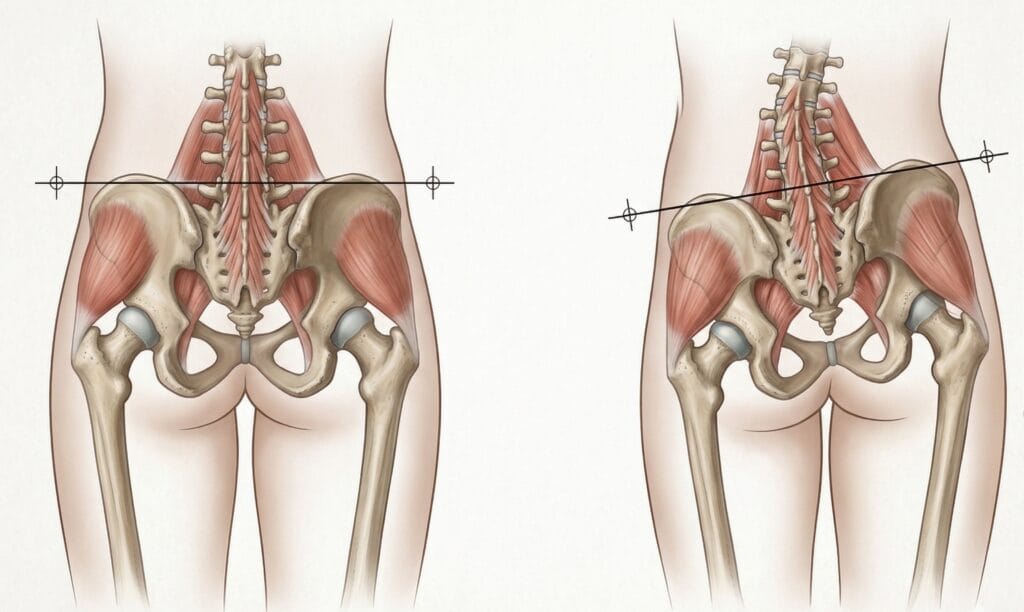
Unlike the anterior tilt, this occurs when the pelvis rotates backward and tilts upward. This flattens the lower back, eliminating the natural, shock-absorbing curve of your spine (often called Flat Back Syndrome).
- How does it look? Your buttocks will appear flat and tucked under, often accompanied by a noticeable rounding in the upper back and shoulders.
- Main Cause: Slouching or excessively sliding down on the couch for extended periods. This causes severe weakness in the lower back muscles and chronic tightness in the hamstrings, which constantly pull the pelvis downward.
The Kinetic Chain: How a Tilted Pelvis Destroys Other Joints
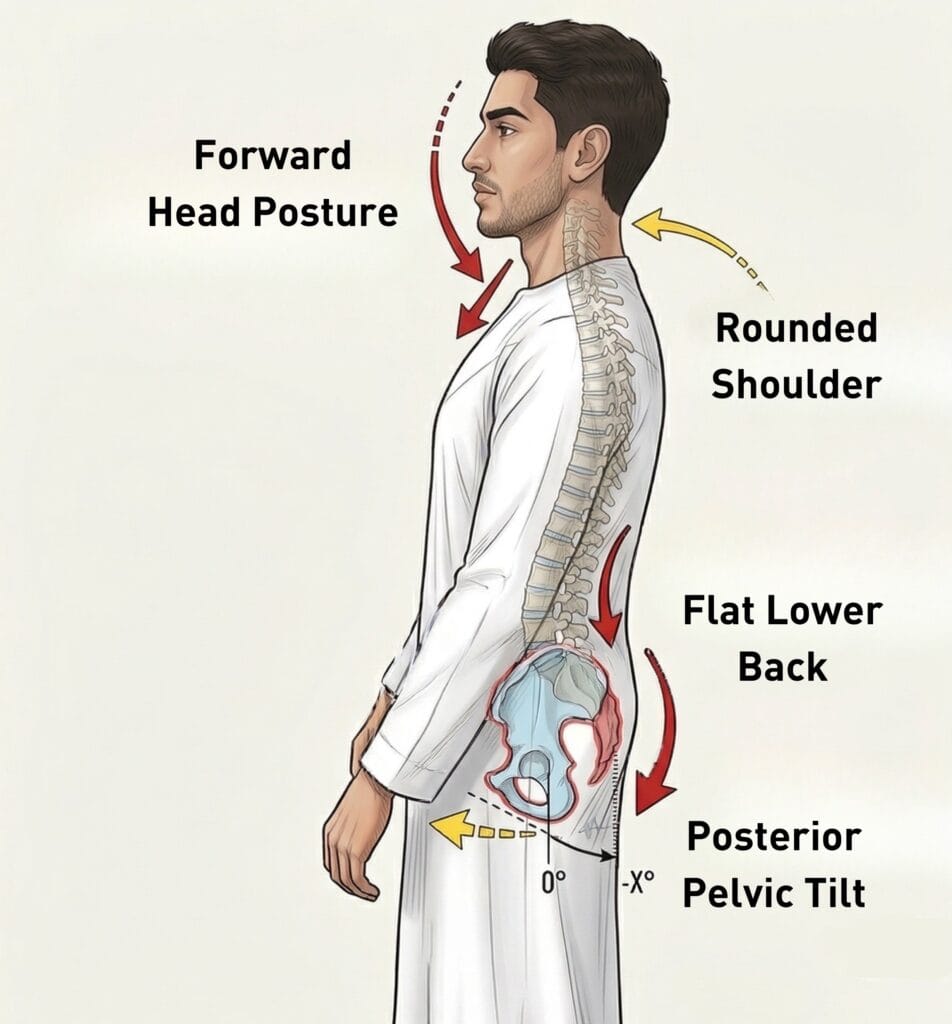
In biomechanics, there is a rule known as the “Kinetic Chain.” This means that a dysfunction in one joint will inevitably transfer stress to the neighboring joints. Because your pelvis is your body’s center of gravity, a tilt doesn’t just affect your back; it triggers a “domino effect” from head to toe:
- Devastating Effects on Knees and Feet: When your pelvis tilts forward (Anterior Tilt), it forces your thigh bones (femurs) to rotate inward. This internal rotation forces your knees to cave in (Knock Knees), which flattens the arch of your foot, leading to “Flat Feet.” Suddenly, a pelvic issue turns into chronic knee and foot pain when walking!
- The “Lower Belly Pooch”: Many slim individuals suffer from a stubborn lower belly bulge that won’t go away with diets or crunches. The reason is purely mechanical: the forward tilt of the pelvis physically pushes your internal organs outward, and weak core muscles fail to hold them in.
- Neck Pain and Headaches: How does a pelvic problem reach your head? When your lower back arches excessively, your upper back is forced to round forward (hunch) just to keep your eyes looking straight ahead. This forces your neck into a “Forward Head Posture,” causing chronic shoulder tension and triggering debilitating Cervicogenic Headaches.
4 Hidden Daily Habits That Twist Your Pelvis
A pelvic tilt does not happen overnight; it is the cumulative result of movement habits we perform unconsciously every day. If you want to maintain a balanced pelvis after your chiropractic sessions, you must break these habits immediately:
- Standing on One Leg: Do you notice that when waiting in line, you lock one knee and shift all your body weight onto one hip? This drops one side of the pelvis and raises the other. Over months, your pelvis becomes “locked” in this Lateral Tilt.
- Crossing Your Legs While Sitting: Constantly sitting with one leg crossed over the other causes “Pelvic Torsion” (twisting). This stretches the muscles on one side while shortening them on the other, severely straining your Sacroiliac (SI) joints.
- Carrying Kids or Bags on One Side: Mothers who always carry their toddlers on one hip, or professionals carrying a heavy laptop bag on one shoulder, force their spine and pelvis to constantly bend sideways to compensate for the weight.
- Sleeping in a Tight Fetal Position: Sleeping with your knees pulled tightly to your chest all night keeps your hip flexors in a shortened, contracted state for 8 hours. When you stand up the next morning, those shortened muscles aggressively pull your pelvis forward.
4 Symptoms Telling You It’s Time for Pelvic Tilt Treatment
Your body does not stay silent about mechanical dysfunction; it sends constant warning signals. If you experience these symptoms, your pelvis is likely the culprit:
- Constant, Aching Lower Back Pain: Especially noticeable when standing or walking for long periods, as your lower back muscles are locked in a painful, continuous spasm trying to hold you upright.
- Severe Tightness in the Front Thighs: You constantly feel stiffness in the front of your hips/upper thighs, and standard stretching never seems to make it go away.
- Uneven Knee or Ankle Pain: Due to a lateral pelvic tilt, your body weight is distributed unevenly, placing crushing pressure on one knee or ankle more than the other, leading to early cartilage wear and tear.
- Neurological Symptoms: A twisted pelvis can compress the lower nerve roots, causing a sharp, radiating pain down your leg that perfectly mimics Sciatica.
A Quick At-Home Test: Do You Have an Anterior Pelvic Tilt?
To see if you suffer from the most common issue (Anterior Pelvic Tilt), try this simple “Wall Test” at home:
- Stand normally and lean your back flat against a straight wall (your heels, buttocks, and upper shoulders should be touching the wall).
- Now, slide your flat hand into the space between your lower back and the wall.
- The Normal Result: The gap should be just tight enough for your hand to slide through comfortably (about the thickness of your hand).
- The Positive Result: If there is a massive gap (you can easily slide your entire arm or a closed fist through), it means your lower back arch is severely exaggerated, and your pelvis is aggressively tilted forward!
Simple Home Exercises to Jumpstart Your Pelvic Alignment
Before proceeding to professional chiropractic adjustments, you can help your body at home by targeting the tight muscles pulling your pelvis out of place. Here are two highly effective and safe exercises to start with:
1. Kneeling Hip Flexor Stretch
This is a golden stretch for relieving an anterior pelvic tilt. Drop down onto one knee (like a proposal stance), keeping your front knee at a 90-degree angle. Keep your back completely straight, engage your core, and gently push your hips forward until you feel a deep stretch in the front of your resting leg’s thigh. Hold for 30 seconds and switch sides.
2. Supine Pelvic Tilts
Lie flat on your back with your knees bent and feet flat on the floor. You will notice a natural gap between your lower back and the floor. Engage your core muscles and press your lower back firmly against the floor, forcing your pelvis to rotate into a neutral position. Hold this tension for 5 seconds, then relax. Repeat 10 to 15 times to wake up your deep core muscles.
How Chiropractic Provides Lasting Pelvic Tilt Treatment
Trying to fix a pelvic tilt with just exercises or wearing a posture brace usually fails. Why? Because the joints themselves are often mechanically “locked.” You cannot properly strengthen a muscle if the joint it attaches to cannot move.
At Rikaz Clinic, proper pelvic tilt treatment fixes the root of the problem:
- SI Joint Adjustments: Your Doctor of Chiropractic applies gentle, specific pressure to unlock the Sacroiliac joints, allowing the pelvis to naturally return to its balanced, neutral position.
- Lumbar Spine Decompression: Adjusting the lower back vertebrae to reduce the exaggerated arch and relieve the suffocating pressure on your discs and nerves.
- Muscular Rebalancing (Rehab Protocol): Once joint mobility is restored, we guide you through highly specific exercises:
- Stretching: To lengthen the stubbornly tight hip flexors and lower back muscles.
- Strengthening: To activate your deep core and glutes, acting as a “natural corset” to hold your pelvis in its newly corrected position.
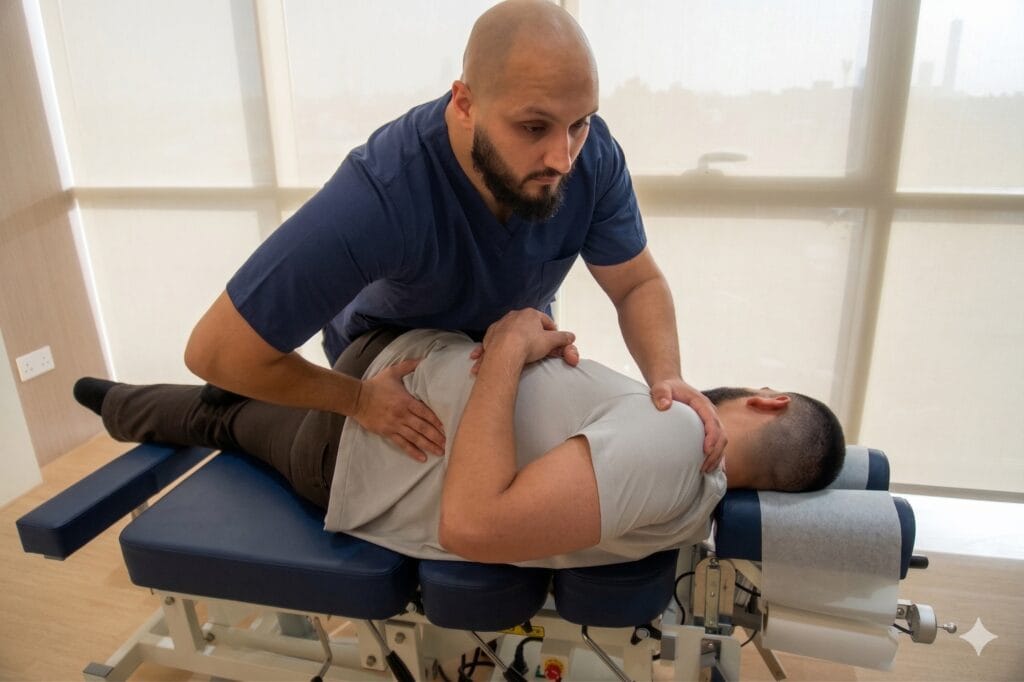
The Rikaz Methodology: Precise Biomechanical Engineering
Rebalancing the human pelvis is a bioengineering process; there is no room for guesswork.
Led by Dr. Mohammad Yashar, who completed an intensive 5-year academic degree at the prestigious RMIT University in Melbourne, Australia, we guarantee evidence-based care. Our protocol always starts with:
- A meticulous mechanical assessment of your gait (how you walk) and standing posture.
- A precise measurement of your leg lengths to determine if the tilt is structural (bone length) or functional (muscle/joint related).
- Expert analysis of your X-rays to clearly see the exact positioning of your pelvis and spine before any treatment begins.